By Sheridan Wimmer on September 9, 2026
She is the farmer
A look at recent survey data about women’s leadership roles in agriculture
Leadership isn’t limited to certain people based on their gender, ethnicity, age or socioeconomic status. Being a leader comes as varied as humans and comes at us in diverse ways every single day. From teaching our kids to not litter or to apologize when they hurt someone’s feelings on the playground, all the way to leading an organization with empathy, confidence and poise, the choices we make determine the type of leader we are in every situation. After all, leadership is an action, not a role.
That same sentiment is also true on a farm or ranch — it isn’t limited to age, gender or any of the characteristics that make us, well, human. Historically, and maybe a bit stereotypically, in the U.S., a man might be seen as the farmer or rancher while a woman’s role was diminished — no matter what they do or how much of the farming or ranching they facilitate.
WOMEN IN AG STUDY
American Farm Bureau Federation’s (AFBF) Women’s Leadership Committee, in partnership with CoBank and JBS, facilitated a survey and focus groups to identify essential roles women currently play in agriculture and their opportunities for leading.
“This year marks a celebration of the International Year of the Woman Farmer,” says Marieta Hauser, a Kansas Farm Bureau board member representing the organization’s 9th District in southwest Kansas. “But women in agriculture have long played integral, starring roles on the farm and in their communities. I appreciate AFBF taking a closer look at the ways women lead, the ways we want to grow and how organizations like Farm Bureau can be the conduit to fostering leadership actions.”
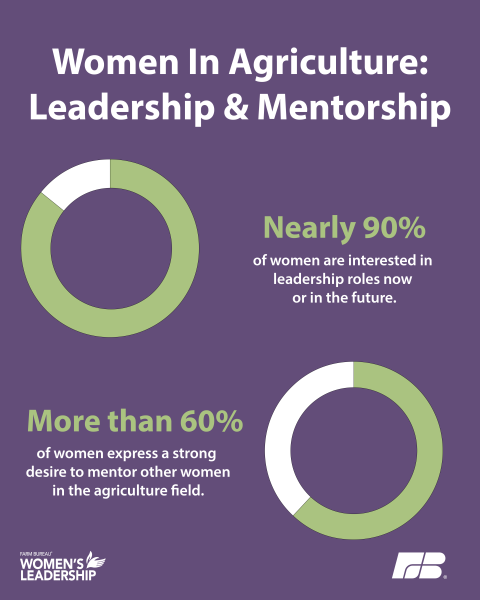
The survey collected more than 4,000 responses and found women in agriculture are ready and engaged, but they also report facing some challenges.
Ninety percent of the respondents said they are willing to participate publicly in leadership roles now or in the future. Women in agriculture also have strong confidence in their ability to balance farm work and family responsibilities while at the same time reporting the agriculture sector could increase support in areas of time and caregiving, skill development, leadership involvement, financial future and overall wellbeing.
“While that may seem like a bit of a contradiction, it’s mostly telling us both things can be true at the same time,” says Stephanie Basey, a rural health researcher who worked on the AFBF study with Dr. Anne Montgomery, Dr. Helen DuPree and Tatiana Alcocer. In Basey’s work, she focuses on stress, resilience and access to care in agricultural communities. “It tells us that the work women do on the farm, ranch or in their rural community is hard, but they’re doing it anyway.”
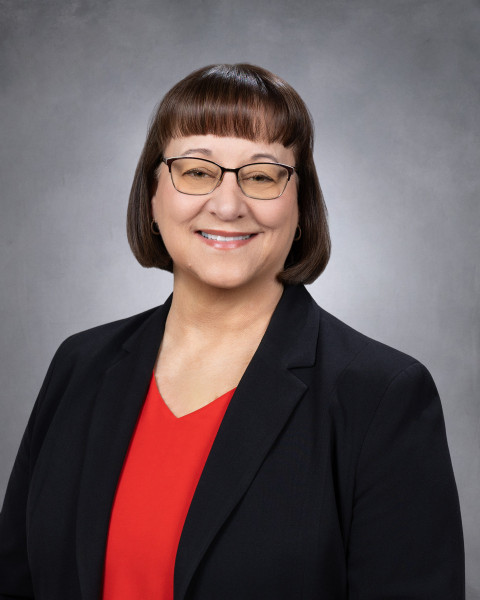
 Laura Haffner serves as the Kansas Farm Bureau Women’s Leadership Committee chair and owns and operates a custom harvesting operation with her husband and two children. Her family cuts wheat and small grains from north Texas to the Canadian border each summer. She is busy, and she’s frank about her roles in every aspect of her life — caring for children, caring for aging parents, caring for land and caring for others is a lot to juggle. She also prioritizes her own care — of course, when she has the time.
“I’m proud of the work I do in agriculture,” Haffner says. “But I also have an identity outside of custom harvesting and farming. I am teaching my kids that leading with kindness is a leadership skill in itself. In a world that’s increasingly divisive, being a leader is hard but necessary. The Women’s Leadership Committee, both at the state and national levels, are creating a space for women to be taken seriously but it doesn’t start or stop with the committee. Leadership, to me as a woman, also means knowing I deserve a spot at the table, regardless of who else is there.”
ACTIONABLE LEADERS
The AFBF Women in Agriculture survey provided topline actionable suggestions, like developing a long-term pipeline for women in leadership positions in agriculture; creating easier access to knowledge and networks and fostering meaningful engagement to sustain leadership.
Starting a leadership pipeline should begin earlier than we might imagine. The survey indicated leadership starts before 25, often before 18.
“One of the more pinpointed, strategic implementations from the results of the study is to implement and invest, and it doesn’t have to be a lot of monetarily investing, in youth programming to get them started on the leadership pipeline earlier,” Basey says.
With programs like Kansas Farm Bureau’s Young Farmers and Ranchers, 4-H and FFA, developing leaders in agriculture can be built early when programming is enticing and approachable.
ACCESS TO KNOWLEDGE AND NETWORKS
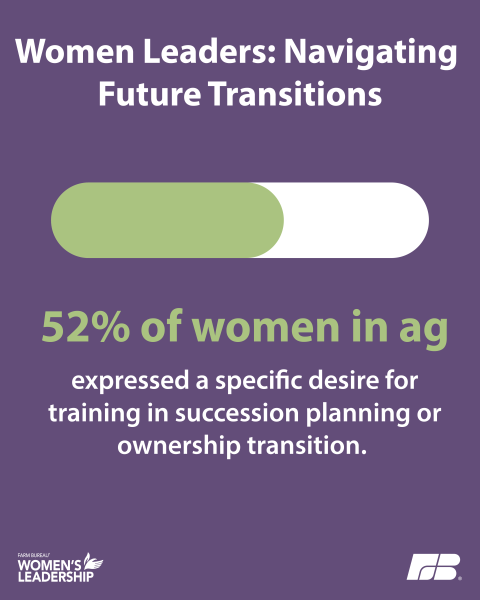
While the survey respondents have confidence in themselves, there were some areas where access to specialized knowledge was lacking. More than half (52 percent) of respondents said they were interested in training related to farm succession or ownership transition.
“I know there’s been a lot of discussion from Farm Bureau and other organizations about succession planning and the impact it has on the women on the farm or ranch,” Basey says. “There were stories of how women navigated widowhood after their husband passed away and how they were treated as though they also didn’t live on the same farm for 40 or 50 years and felt pressured to sell. There’s an opportunity to facilitate conversations about what the woman needs to know when the primary farmer passes away if that’s their situation.”
There were also signals of a generational continuity gap for women in agriculture to have someone they can depend on who understands and can provide perspectives.
“Agriculture is based on relationships, and I think building genuine relationships and trust is really important,” Haffner says. “I think it’s crucial to have a mentor and be a mentor yourself, too.”
FOSTERING MEANINGFUL ENGAGEMENT
When there is time to step away from the farm or ranch, the survey indicated organizations should make sure the programming being offered is meaningful and impactful for those attending. One of the elements of improvement offered in the study is translating something informal into a leadership-focused, formal agenda. It’s imperative to make sure that when women step away from their leadership actions on the farm, ranch, community and home to take part in organizational leadership, that it’s worth the additional barriers they’ve worked through.
“Organizations can look at the burdens there are for women to be in leadership positions and find ways to minimize that burden,” Basey says.
"One thing that has made Farm Bureau accessible for me is the family-friendly experience I’ve had,” Haffner says. “If Farm Bureau had not welcomed my family alongside me in my leadership journey, it would not have been possible because of our farm lifestyle."
Even with actionable items for organizations to implement change for women to have fewer barriers, the work takes time. And this is not to say women aren’t stepping into leadership positions already. They’re doing hard things and leading homes, farms, ranches, communities and more. They’re leaders, even when it’s hard.
“One of the things I hope women take from the survey is that they’re not alone,” Basey says. “Strengthening women often strengthens their community. And a lot of times, facilitating change in communities happens through agriculture.
“There’s so much nuance in agriculture and we found that to be true in this study, primarily in the focus groups. How women perceive themselves on the farm, ranch or in their community varied, but in many of the responses we heard, even if they did or didn’t think of themselves as farmers, they absolutely were. I wanted to respond to them and say, ‘Yes, you are a farmer!’”
If you’re interested in growing as a leader, please contact your local county Farm Bureau. From serving as a board member to getting involved in leadership programs like the Women’s Leadership Committee, Kansas Farm Bureau is ready to help you make your next leadership action.


Sheridan Wimmer
Born and raised in Kansas, Sheridan Wimmer has an appreciation for the state’s agricultural diversity. Representing the best interests of Kansas farmers and ranchers is Sheridan’s jam (or jelly, no discrimination). Great food and wine are at the top of Sheridan’s sustenance list and she knows it wouldn’t be here... Read more