By Brandi Buzzard on September 8, 2026
Herd Size, Beef Prices and Importing Beef
An inside look at how policies are impacting a rancher
Editor's note: Things move and change quickly in this world of politics. The following article was written by a rancher in Kansas following a proclamation by President Trump and how it would impact her and her ranch. This issue is very nuanced and there's a lot at play in the cattle industry. Bottom line: we support the United States' food supply chain, its producers and the procedures in place to protect our food supply.
Something tells me it’s time for a crash course on the basics of beef imports, exports and food safety in the United States.
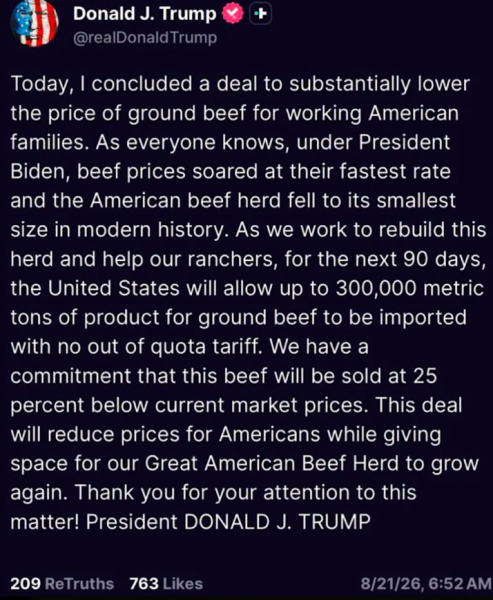
Leading off, most readers have heard or read about the decision — which started as a social media post — from President Trump to import an additional 300,000 metric tons of lean beef trimmings, which will not be subject to out-of-quota tariffs. Here is the post in its entirety, and here is a refresher on tariff quotas.
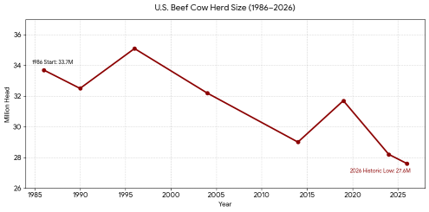
To clear up a few things, the beef herd has been shrinking steadily for the last 30 years, with a single spike in 2019, following a very significant post-2015-16 drought rebuild. The most recent herd reduction from 2019 to current day herd size is due to another very prolonged drought spanning several years, spread across significant cattle producing areas. Basically, this is not a new issue that can be confined to just a few years, nor one specific issue. It’s a systemic, nuanced long-term trend.
Below, in the top chart, you can see the trend of the number of cows in the U.S. over time. The bottom chart shows drought area in the United States over time, outlined by intensity. The dark red section is “exceptional” drought, and the lighter red is “severe” drought. You’ll notice when there are greater instances of exceptional and severe drought, the cow numbers decline, and vice versa.
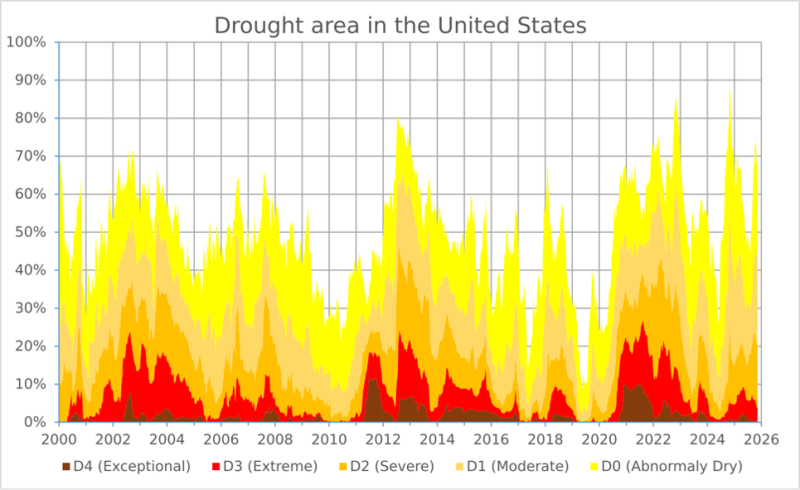 How does drought relate to beef prices? Well, as drought persists and grass shrivels and dies, cows still need to eat! When there’s no grass left in the pastures, ranchers will resort to buying hay and other feeds to get by, until they can no longer afford to keep the cows fed. And then — in some instances — faced with feeding their family or feeding the cows, ranchers are forced to sell their cows at the auction market. When there is widespread drought, like we’ve been experiencing for the last four to five years, thousands of ranchers across the nation are hauling cows to the auction market and the cow herd declines.
With fewer cows in the herd, there are fewer calves born every year. Fewer calves being born leads to fewer calves being raised for beef, which creates a smaller supply and pushes beef prices higher. Compounding the effects most recently are the historically high prices for both live cattle and beef, which are incentivizing ranchers to keep selling their calves, instead of keeping some to raise into cows and start rebuilding the herd.**
So, that’s why the cattle herd is the smallest on record. Which brings us to importing beef to relieve beef prices.
The president stated the U.S. would receive 300,000 metric tons more imported lean beef trimmings, which is roughly 661,000,000 pounds of lean beef. The additional imported beef would be limited to countries that don’t have specific import quotas and would not be subject to out-of-quota tariffs, meaning there will still be a small tariff, less than 5 cents/kilogram, which is much lower than the out-of-quota rate of 26 percent.
The news has unsurprisingly frustrated ranchers who are experiencing meaningful revenue and profitability for the first time in many years. Some ranchers view these last few years as life-changing income and have been able to bring another family member into the fold, pay off debt or retire altogether and relax. Hence, importing 661 million pounds of beef, fundamentally, would increase supply and lower beef prices across the board — a benefit to consumers but not for ranchers.
The beef is due to start arriving on Sept. 1, and I want to remind readers it’s being accepted as lean beef trimmings. It is not beef that has already been ground – think of it as the strips or edges trimmed off a roast or other large cut. The imported beef is purchased by beef packers and processors and then combined with fat and ground to the desired lean-to-fat ration (93:7, 90:10, 80:20, etc.). It’s then distributed to restaurants, foodservice and some grocery stores, although the majority of the beef will end up in restaurants and fast food because, as I’ve mentioned previously, Americans have a strong demand for hamburgers. Our beef in the U.S. is of such high quality, we export some of our premium cuts instead of keeping them here for ground beef. And all imported beef is subjected to the same testing and standards by the USDA Food Safety and Inspection Service as domestically produced beef. So, before the beef ever hits your grocery shelf or restaurant table, it has passed through FSIS inspection.
The 300,000 metric tons of beef is scheduled to arrive in the U.S. over the next 90 days. In his post, President Trump indicated this move is designed to achieve two things; 1) lower beef prices for consumers and 2) give ranchers time to rebuild our herds.
Friends. Dear readers. If you’ve seen a new calf and then gazed upon a full-sized cow, you know it takes more than 90 days for a calf to be ready for steak transformation. Will this move make a difference in beef prices at the grocery store? Possibly. But bear in mind, packers and processors may purchase the beef with the much lower tariff rate but are under no obligation to pass the savings on to consumers at the grocery store level. Noticeably, there are no indications in the social media post or the ensuing proclamation that there will be measures taken to pass those savings on (and I don’t know how it would be monitored, to be completely honest).
Ranchers will not be able to rebuild the beef herd in 90 days. It will take meaningful rainfall and the promise of good grass and forage availability for ranchers to start retaining their heifers instead of selling them to feedyards for beef. However, with prices as high as they are, I can’t say I would blame any rancher who would rather take the money for a calf now instead of waiting to raise a heifer up and hope for profit in two to three years.
This announcement has certainly upset ranchers as well as the cattle market, as feeder cattle prices have tumbled over the past few weeks. I don’t think I’m alone when I say I’d appreciate it if President Trump and his administrative colleagues would seek insight from experienced ranchers and ag economists before making such monumental moves that clearly have far-reaching effects.
-----------------------------
** Although impactful, I did not mention the movement of New World screwworm into the United States from central America and Mexico and how the closing of the southern U.S. border for 15 months affected overall cattle numbers on feed.
More information:
- AFBF Analyzes Potential Beef Import Impacts: Urges President Trump to Reconsider | News Release | American Farm Bureau Federation
- Imports Will Discourage America’s Beef Recovery | Farm Bureau Intel Markets | American Farm Bureau Federation
- Relaxing Beef Import Quotas Sends Mixed Signals to Ranchers | Farm Bureau Intel Markets | American Farm Bureau Federation
- Beef Production 101 | Farm Bureau Intel Markets | American Farm Bureau Federation