By Sheridan Wimmer on June 10, 2026
Celebrating centuries of resilience
Kansas Farm Bureau’s Century and Sesquicentennial Farm programs honor the rich legacy of farming and ranching — and for America’s 250th birthday, we’re giving her stories to be proud of.
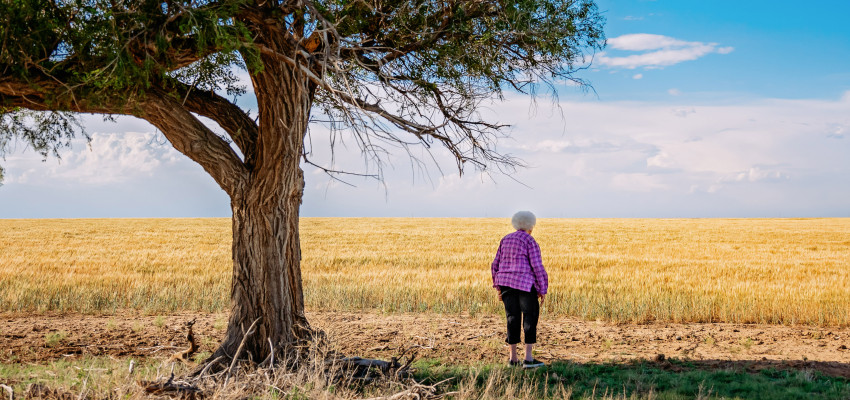
Lohman photos by Kerstin Mitchell of Western Images
Smith photos by Sheridan Wimmer
America turns 250 years young on July 4 this year. She doesn’t look a year over 29 to us, but 250 years is a legacy worth celebrating. The foundation of America was built with determination, grit and resilience — similar to the attributes of farmers and ranchers across our nation. Kansas Farm Bureau (KFB) has long celebrated this farming and ranching legacy with its Century Farm program, honoring families who have stood the test of time to keep their legacy alive in agriculture for 100 years and counting.
Numerous farm and ranch families send their documentation to KFB each year to be celebrated. In 2026, 62 farms were recognized as Century Farms and, an additional program, the Sesquicentennial Farms program, honored 32 farms for 150 years of resilience. Since the programs started, 3,326 farms have received Century Farm designation, while 186 farms have been recognized as a Sesquicentennial Farm. The stories of these farms and ranches are rich — here are two of them.
Story 1. The Lohman family in the Western Frontier
In 1926, Lewis and Katherina Lohmann (one of the n’s in Lohmann was later taken off) moved to Kearny County in 1926 from WaKeeney to purchase land and begin their farm and family, where they had four children — Raymond, Ella, LeRoy and Alice. Raymond and LeRoy farmed together until they retired. LeRoy married Ruby Wright in 1949 and had five girls together — Vicki, Carol, who passed away in 2018, Lorra, Kim and Connie. Once LeRoy retired, he and Ruby moved to Lakin, which is where Ruby still resides. LeRoy passed in 2012, but his memory and legacy live on in the stories shared about him and the farm.
The Lohman women describe LeRoy as your typical farm and ranch man — patient (but maybe a little short on that when working cattle, as one is), modest and kind.
“My dad was a patient man,” Kim says. “Well, maybe until he was working cattle. That’s the only time we ever heard him say a naughty word.”
“He was a very good man,” Ruby says. “He was kind and just an all-around good fellow.”
A ruby in the rough
Ruby, a nonagenarian, sits with her daughters and shares stories of raising five girls with LeRoy in rural Kearny County. You can hear the dichotomy of sweetness and strength in Ruby as she recalls the joys and discomforts of farm life.
“My favorite part of farm life were the baby calves,” Ruby says. “I loved being able to look out of the window and see them playing and running around.”
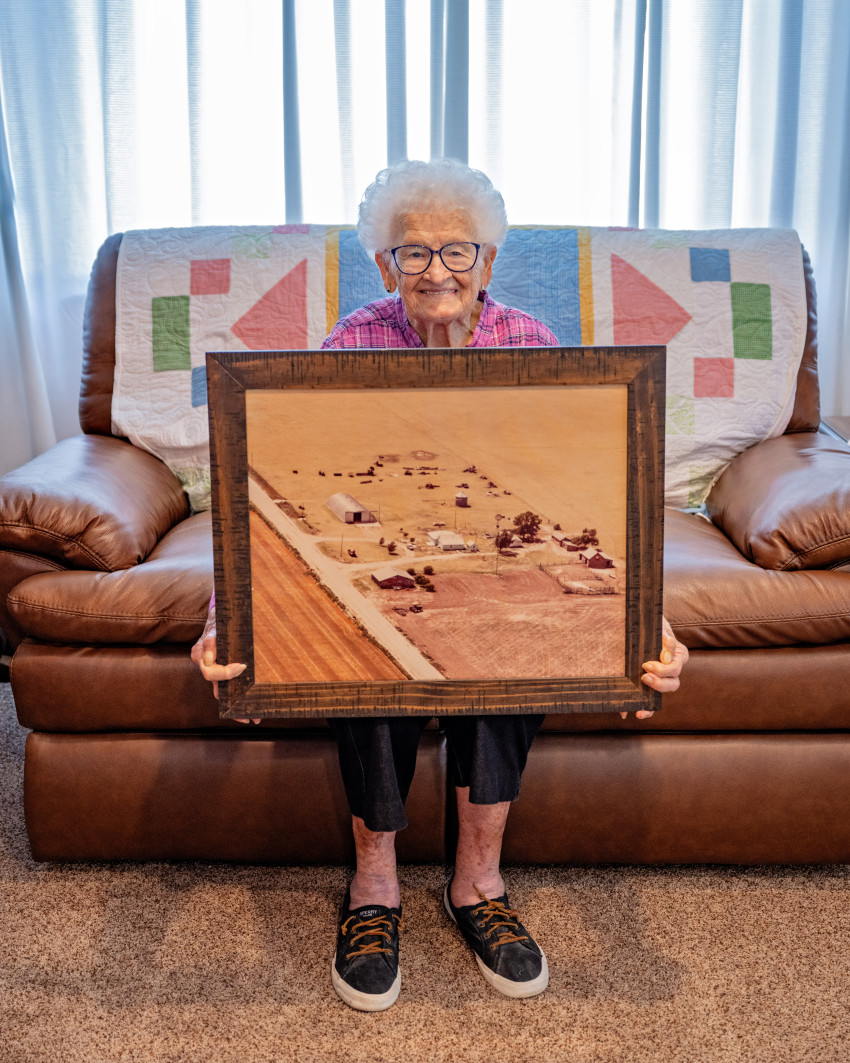
Ruby Lohman sits with an aerial image of her farm in Kearny County.
“I remember the blizzard of ’57, mom and dad had a rope to get out to the barn,” Vicki says. “My mom told me to watch the girls and not leave the house, even if she didn’t come back in. We had no electricity. Mom went out to the barn all wrapped up, trying to save baby calves.”
Playing in dirt
Dirt seemed to be a lovely thing growing up for the Lohman family; seeing it through a child’s eyes with joy, excitement and the feeling of accomplishment.
“We loved when dad came home from working the fields,” Kim remembers. “This was before tractors had cabs and he would be covered in dust. All you could see were his eyeballs and his white teeth as he smiled.”
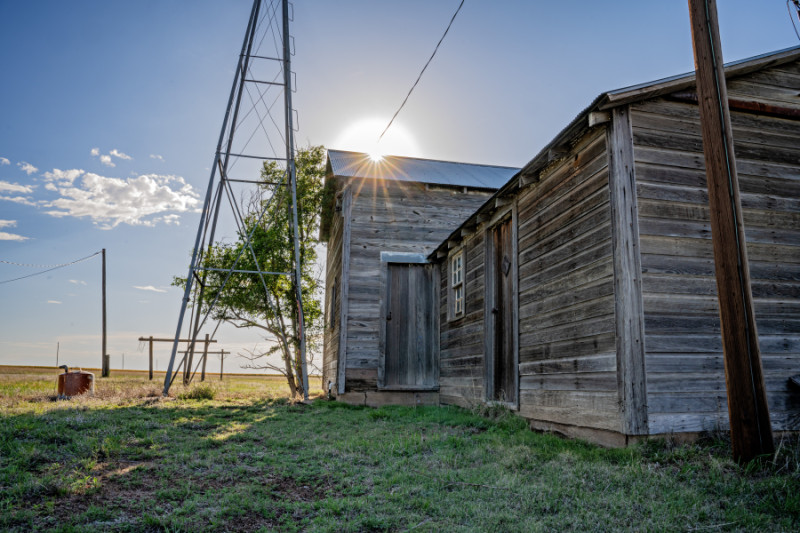 In an article about the Lohman family history, it recalls Raymond and LeRoy having a good wheat crop in 1942, but subsequent years would prove to be dry in the High Plains — an ever-present situation for much of Kansas. The Lohmans planted primarily wheat and some grain sorghum on dry land and the lack of moisture made farm life hard at times.
“The hardest part was waiting for moisture,” Ruby says. “Being a farmer is very hard work.”
“Farming requires you to rely a lot on faith and prayers,” Kim says about waiting for rain.
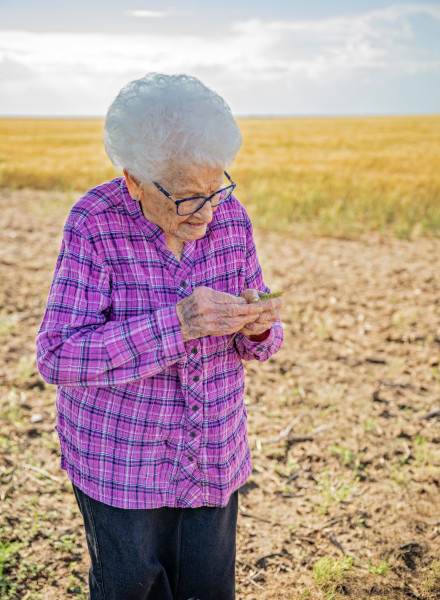 Sometimes the rain didn’t come, but planting had to be done. Having the five girls help on the farm wasn’t only a necessity for the Lohmans, but it also was a source of some ulterior motives at times.
“One of our favorite things to do growing up was to sit in these boxes that were pulled behind the tractor that needed weight to them so they’d go deeper in the ground when planting,” Kim remembers. “We would get so dirty. But we loved it because we were helping farm. Although, now that we think back on it, we’re not sure if dad really needed us as the extra weight or if our mom just needed us five girls out of her hair.”
Changes in technology
Between 1926 and 2006, there have been an insurmountable number of changes in our society — and agriculture is no stranger to technological advancement. In 1926, many farmers switched from literal horse power to mechanized horsepower for fieldwork, and 100 years ago was when Pioneer Hi-Bred developed the first hybrid seed corn, helping farmers produce more yields with fewer inputs and higher resistance to issues like drought and pests. Technology has only improved from there, creating opportunities for farmers to be more efficient while improving sustainability.
“My dad went from no cab on the tractor and combine to adding an umbrella to block some of the sun,” Kim says. “Then he went to a cab with no air conditioning, so the windows had to be open. He finally got around to getting a tractor that had a cab with AC in it, but I’m not sure he’d be able to trust all of this computerized farm equipment these days.”
Starting small, staying small
“When mom and dad got married, both sets of our grandparents gave our parents a cow,” Vicki says. “That’s how they started their cattle herd — with just those two cows.”
The sisters hope agriculture finds a way to stay small and to protect family farms and ranches to continue the tradition of the livelihood that brings up so many memories for them.
“I think mom’s biggest thing is she hopes the future of agriculture still is made up of family farms,” Connie says. “Being recognized as a Century Farm means a lot to us because we know how hard our parents worked.”
“I’m very honored and I’m so proud to be here with my girls,” Ruby says of the Century Farm designation.
Ruby and her girls are proud of the land that’s been in their family for 100 years and will continue to be. They’re proud to be part of Kansas agriculture, even in the years when moisture lacked and the calves needed extra help. They’re especially proud to have grown up where dirt was fun, faith was paramount and family was all you needed.
Story 2. Settling with the Smiths
Chester Smith’s parents homesteaded in Logan County in 1887, but after a couple of moves and heartbreaks, moved to Wichita County in 1898.
“Chester’s twin sister, Bell, died just a week after she was born,” Nina Wewer, a granddaughter of Chester, says. “Then his other sister, Blanch, died when they were living in Denver for a short time.”
Chester and his other siblings moved back to Wichita County in 1898. Chester met Minnie Geyer while he was operating the Smith Café after her family moved from Lincoln County in a covered wagon to just south of Marienthal in 1904. They married in 1913, then in 1916, moved to a sod house 11 miles north of Leoti with their son, Harry. After Chester passed away in 1926, Minnie and Harry built a three-bedroom home on the same land as the sod house.
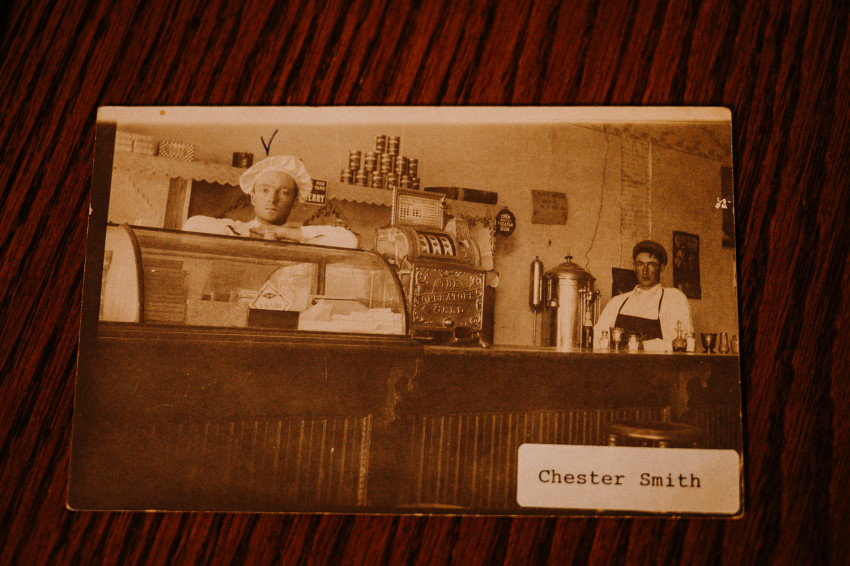
Chester Smith (left) worked at the Cafe in Leoti. His farm was designated a Kansas Farm Bureau Century Farm in 2026.
Harry married Grace Zink of Healy in 1939 and had a daughter, Marcella, who was stillborn at their farm home. In 1941, Janice was born, then in 1944, they had Zada. Years later, in 1952, Nina was born.
“My parents wanted a boy and thought I would be one, so they gave me a middle name of Jo,” Nina says.
Minnie and Co.
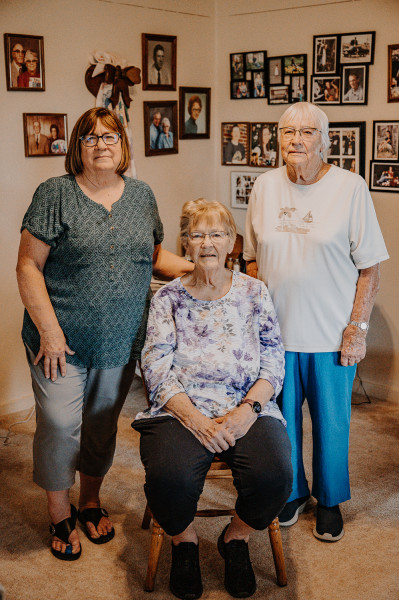
Janice, Zada and Nina are now the three sisters on the Smith land. Zada still lives in the house her grandmother and father built together, while Janice and Nina live in Leoti city limits. They have loving memories of their time with their grandma, remembering how present she was.
"Grandma Minnie lived with us until I was about 8 years old, I think,” Janice says. “She was our nanny; she played with us all the time. Daddy did the fields and the cattle; mom did the garden; Grandma played with us."
Grace and Harry were a team who managed the day-to-day operations of the farm and garden. The girls reaped the benefits.
“We were kids and we just played and played,” Janice says. “We had no worries.”
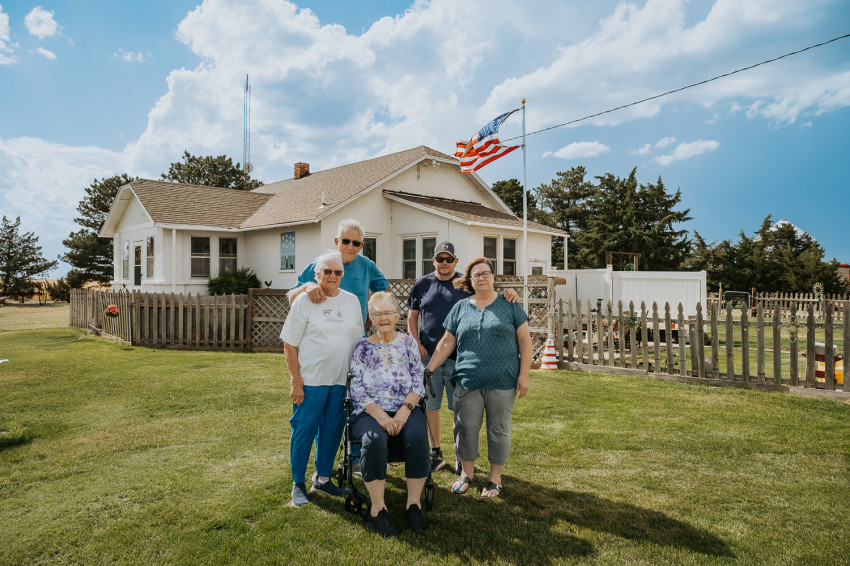
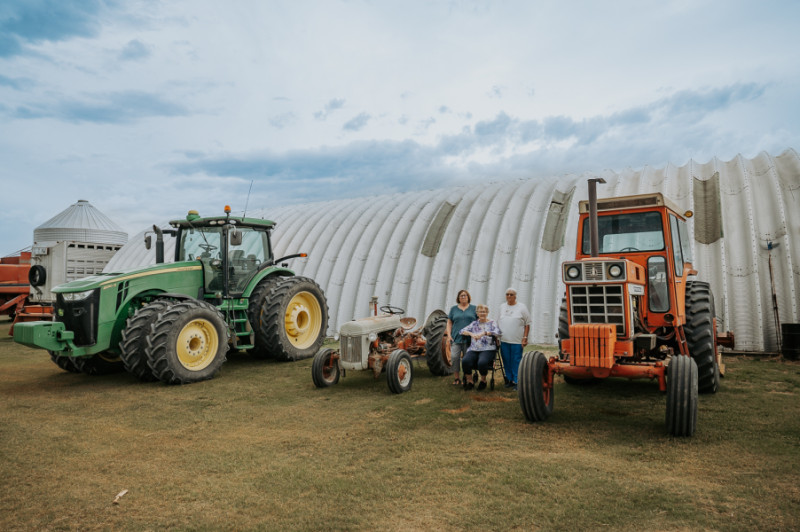
Zada and her husband, Robert Weilert; Janice Rewerts; and Gary and wife, Nina Wewer, stand at their Century Farm home in rural Wichita County.
“I don’t think my mom ever bought food from the grocery store,” Nina remembers. “They raised the beef they canned and we all ate; we had around 100 chickens growing up and we obviously had fresh produce from mom’s garden. We were set.”
That kind of self-sufficient food system is the goal — grow and raise your own food for your family. While that isn’t the norm anymore, for the Smith family, it was all they knew.
“It was not out of the ordinary for our family to get one truckload of wheat harvested just to plant back the next year,” Nina says. “We didn’t get multiple semis full of wheat back then. I remember my dad leaving to go harvest one day and said to my mom, ‘OK, Gracie, I’m going out to harvest, you better hope I can get a truckload to plant next year.’ And that is vastly different from the expectations of wheat harvest today.”
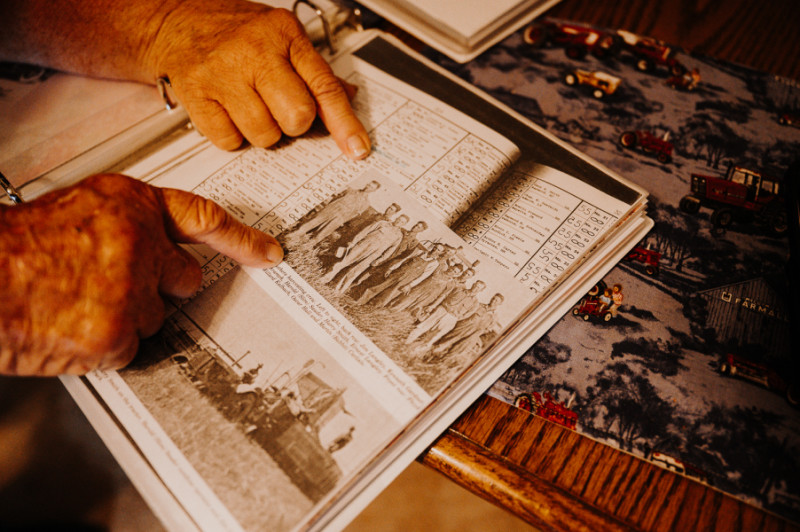
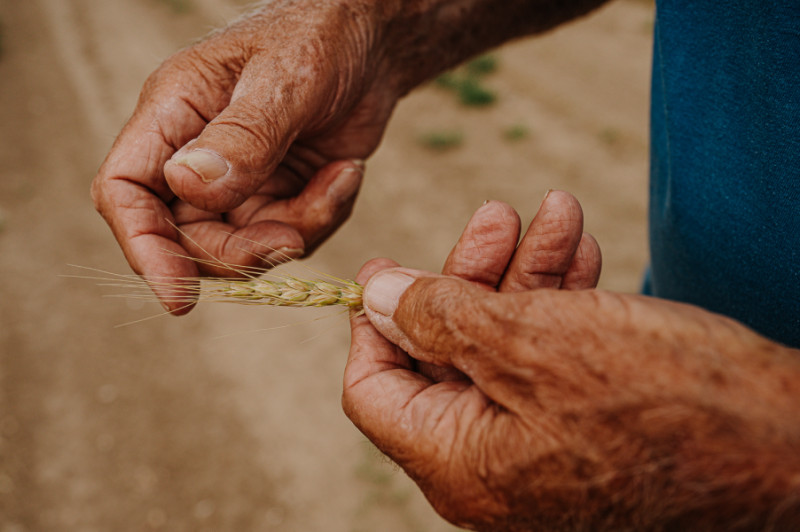
Keeping the tradition alive
Zada and her husband, Robert, passed the farm on to their son and daughter-in-law, Doug and Dixie Weilert. Today, Doug and Dixie operate the farm with help from their two sons, Trenton and Phillip. Trenton submitted the applications to Kansas Farm Bureau as a surprise for sisters Janice, Zada and Nina.
“I know how much this land being in the family for so long means to them,” Trenton says. “Honoring not only where they came from, but where I get to be now and into the future means a lot to our family.”
“It’s shocking to think we’ve had this land that long,” Janice says with a laugh. “We’re lucky Trenton continues to farm and keeps the family tradition going.”
“It’s really nice to be honored,” Zada says. “It’s even better knowing it’s still in our family.”
The sisters have a fun relationship that is full of sisterly correcting and thoughtful care of each other. Through the years, they have experienced the ups and downs of farm living, loss of loved ones and carefree memories. Their love for their grandma, Minnie, is ever-present; she’s even in the corner of the living room, keeping a loving eye on her girls.
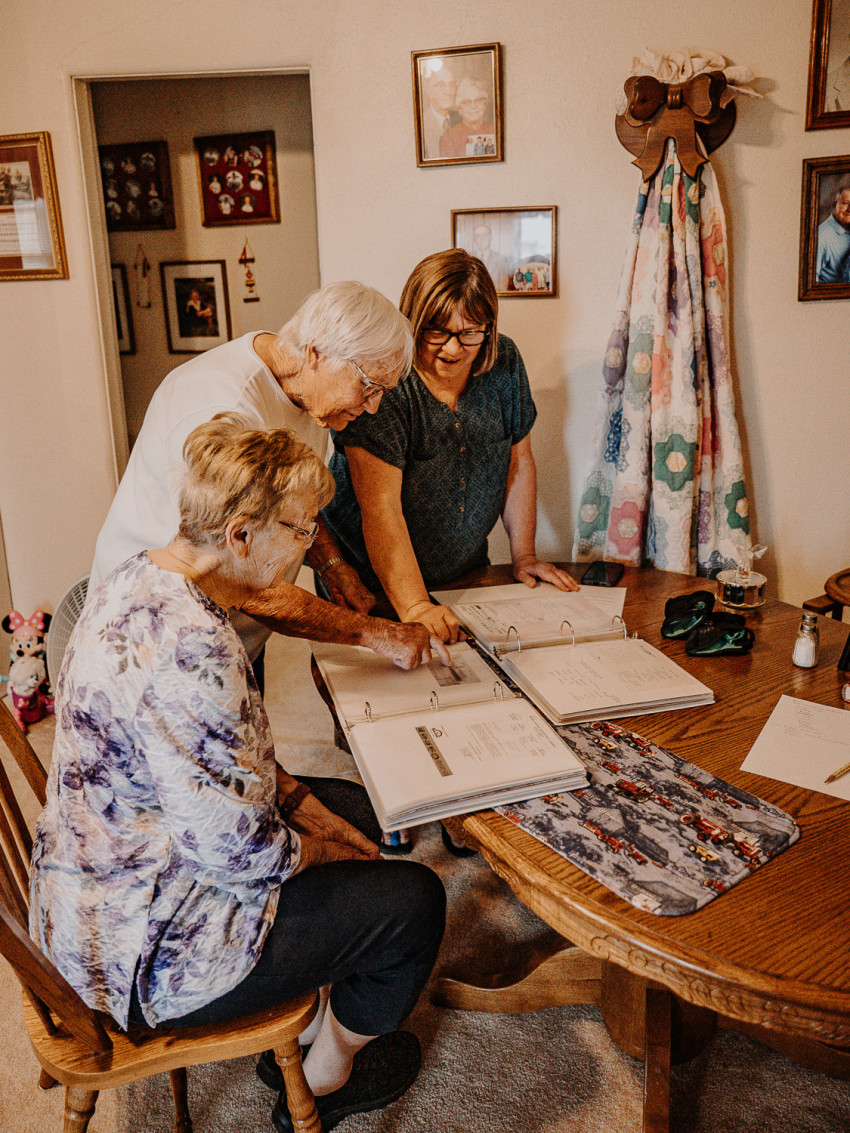
Minnie Mouse, in the center left-hand side of the photo, looks over the sisters as they remember growing up on their Century Farm in Wichita County with their grandma, Minnie.
Happy birthday, America
Stories are meant to be shared; memories are meant to live forever. Honoring the rich tradition and heritage of Kansas’ agriculture, the families who built it and the future generations who continue to care for the land and livestock are paramount to American pride. Thank you to the Lohman and Smith families for their time, commitment to agriculture and continued service to their communities. Happy birthday, America.

Sheridan Wimmer
Born and raised in Kansas, Sheridan Wimmer has an appreciation for the state’s agricultural diversity. Representing the best interests of Kansas farmers and ranchers is Sheridan’s jam (or jelly, no discrimination). Great food and wine are at the top of Sheridan’s sustenance list and she knows it wouldn’t be here... Read more