By Greg Doering on April 20, 2026
Kansas Farmer wins 2025 Kansas Leopold Conservation Award
Rush County farmer and rancher Kevin Wiltse earns Kansas Leopold Award for embracing change in conservation practices
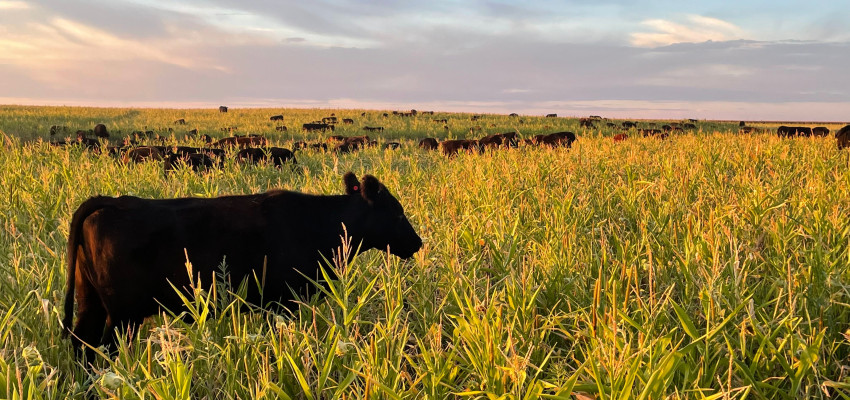
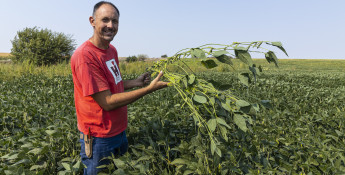
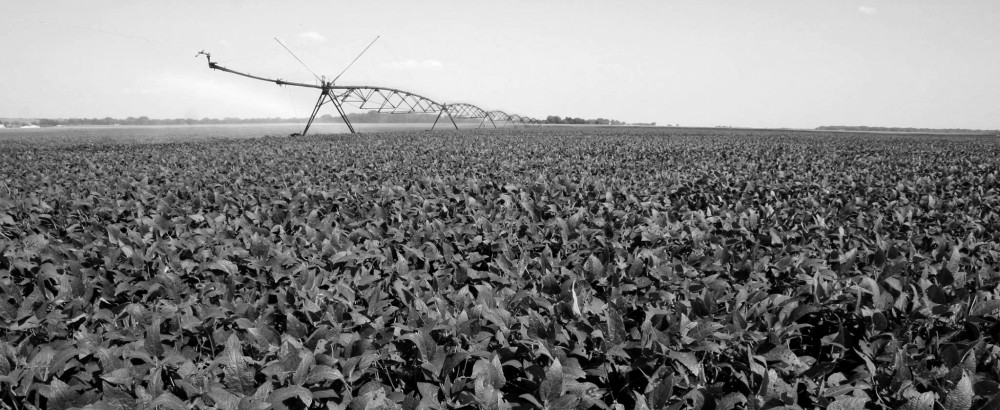
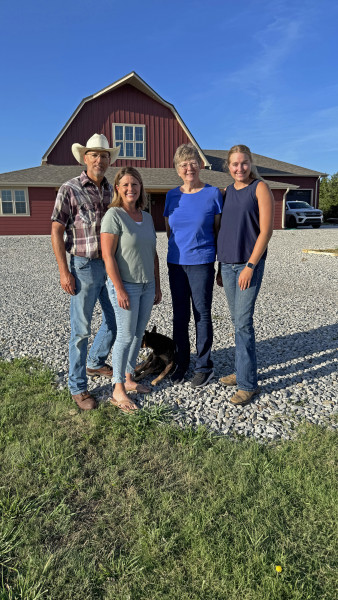
As a fifth-generation farmer and rancher, Kevin Wiltse has observed plenty of changes on the Rush County cropland and pasture where he raises wheat, sorghum, soybeans and cattle.
But it’s his willingness to implement change when he sees something that isn’t working that earned Wiltse and his family the 2025 Kansas Leopold Conservation Award honoring landowners “who go above and beyond in the management of soil health, water quality and wildlife habitat on working land.”
Wiltse’s approach reflects what Leopold Conservation Award judges look for most: management decisions grounded in the realities of the land, where conservation success is measured by long-term resilience, not one-size-fits-all solutions.
Seeds of Wiltse’s award-winning management practices were planted nearly three decades ago when Kevin and his father, Kenneth Wiltse, participated in a bus tour in the late 1990s that demonstrated the advantages of not tilling or plowing crop fields.
“After that trip, we really thought we’d come home and start no-tilling, and that was going to be the answer to everything,” Kevin says. “The next week we ordered a set of no-till drills and sold all our tillage equipment.”
TRIAL AND ERROR
Kevin says it didn’t take long to see that no-till practices where seeds are planted directly into the residue of previous crops weren’t a silver bullet.
“We started no-tilling thinking it was going to solve all our problems like increasing water infiltration, getting rid of our weeds and decreasing all the soil erosion,” he says. “We just found out that wasn’t really happening.”
Adding cover crops like grasses, legumes and brassicas to improve soil health, suppress weeds and prevent erosion also provided forage for cattle to graze, but it didn’t come without some tradeoffs.
“We were pretty aggressive with cover crops from 2011 to 2013, and those were pretty dry years for us,” Kevin says. “We had some pretty good setbacks with the cover crops using too much moisture and hurting the cash crops.”
Through observation, Kevin knew he had to step back and rethink how his conservation efforts fit into a profitable agricultural enterprise.
LEANING ON MOTHER NATURE
After reflecting on the context of the land in semi-arid Rush County, which averages less than 24 inches of rainfall a year, Kevin made the bold decision to convert some cropland back to grass, trading higher per-acre crop revenue for lower overall operating costs.
“We started on some small fields and expanded to fields that probably shouldn’t have been broken out to cropland,” he says.
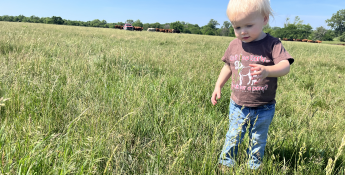
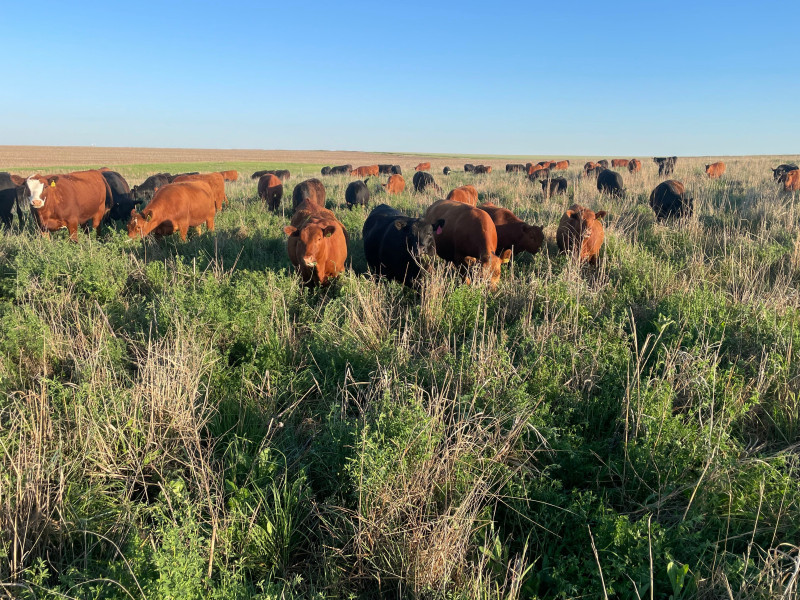
Over the past decade, Kevin says he’s turned about 800 acres of former crop ground into pasture intended for grazing. Just like Mother Nature intended, only with cattle replacing the traditional bison that once roamed the prairie.
“These soils were prairie — they were diverse, perennial mixes with ruminant animals, predators and the occasional fire,” he says. “That was the only management done on this land, that’s what it was and wants to be again.”
BUILDING RESILIENCY
Kevin says his father, who passed away in 2018, had some reservations when he started transitioning larger tracts of crop ground to pasture because it might lower the value of the land. Instead, matching the land to its ideal use increased returns.
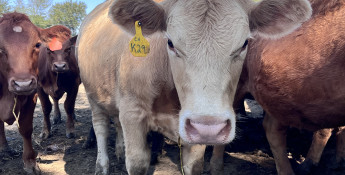
“We’re actually doubling our stocking rate,” Kevin says of the number of cattle that can graze on a particular parcel, which makes it more valuable. “I wish he could see it today because the results are quite amazing. These last four years have been really dry and through managing our grazing and allowing ample rest, we’ve grown a tremendous amount of forage. It’s a testament to the systems we have in place.”
While crop ground is still important on the farm, cattle are the key that makes the tradeoff balance.
“I wanted to build a business that was very resilient and very adaptable to drought,” Kevin says. “We knew to be able to do that the livestock were going to play a key role. I don’t know that it’s drought-proofed our farm, but it really has made it more resilient.”
The changes have nearly doubled the amount of organic matter in the soil, which is crucial for absorbing and storing water. Kevin says he can see the difference between the perennial systems he’s planted and the crop land.
“We’ve seen that through the drought,” he says. “We continue to see green growing forage in dry years when other pastures are brown and dried up.”
LOWER YIELDS, BIGGER PROFITS
In addition to converting cropland, Kevin has made other concessions in the name of conservation, especially with cover crops, which when growing can rob moisture from the soil and reduce the yield on traditional crops.
“That’s Western Kansas,” he says “It’s a balance. For me, what has allowed us to keep going is the livestock utilization.”
For Kevin, the question isn’t how to maximize the yield of an annual crop, but rather it’s how land use decisions drive profits.
“We can take a yield debt and if we manage our grazing we can still have a higher net profit using the cover crops for livestock than the cash crop alone,” he says. “We’ve reduced our herbicides on those acres by 50 to 60 percent. Our nitrogen rates on those acres are down at least 50 percent. That’s just solely because we’re using them for livestock.”
ALL IN CONTEXT
Kevin says he’s fortunate his main farm is contiguous, which has made managing the intensive grazing, where cattle eat most of the forage on a small lot, easier.
“Pretty much anytime we’re grazing a cover crop or on a perennial field, those are all daily moves,” he says. “To make that work economically it has to be that way. We don’t move cattle every day of the year. In the winter we might have cattle on milo stocks for a few weeks. Maybe the herd’s on an 80-acre native patch for a week or 10 days.”
Kevin has also made significant investments in fencing, water lines and other infrastructure in an effort to save time elsewhere, like grazing the cattle through the winter rather than feeding hay or other feed daily.
“We will feed if we have to,” he says. “It seems like in March there’s a few weeks where we’re running out of cover crops and stalks, and the cool-season forages aren’t quite ready where we have to feed some.”
Kevin says the conservation measures he’s implemented are specific to where he’s at in Rush County, noting it wouldn’t necessarily make sense to convert cropland to pasture in other parts of the state.
“We don’t have the greatest soils,” he says. “They’re not bad but they’re sloped and highly erodible. For someone who has flat black beautiful farm ground you might not do some of this stuff.”
NEXT STEPS
Kevin’s initial response when his local conservation districts approached him about applying for the Leopold Award was short and sweet: “I don’t need this.
“I think what we’ve done has had a positive impact,” he says. “I know a lot of other farmers and ranchers who are doing similar things. I’ve learned so much from other people. There’s other people who deserve this award just as much, if not more than me.”
Kevin describes winning the award as a humbling experience that has him thinking more and more about the future, even if it doesn’t include the sixth generation returning to the farm.
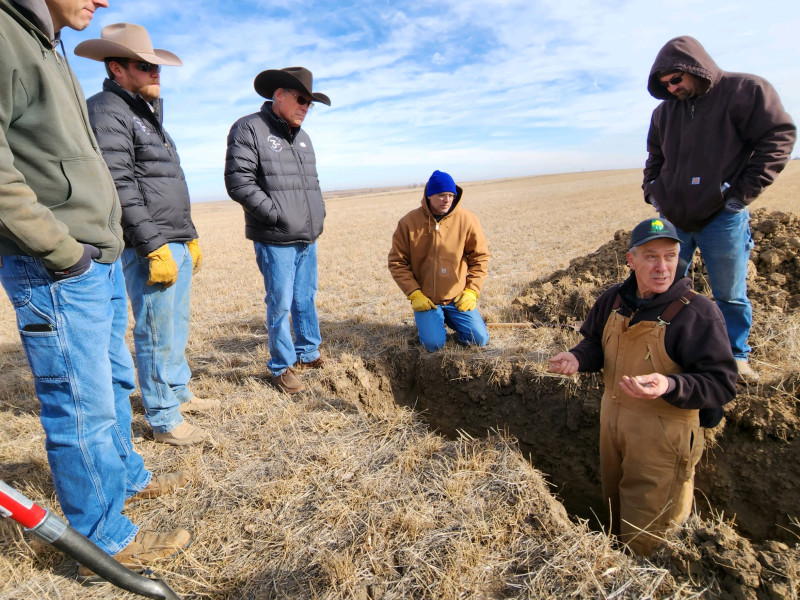
“I think the next step for me is to share what I have learned so the next generations don’t have to make the mistakes I’ve made,” he says. “All my kids understand what I do and why I do it, and the importance to the land and human health. Even if they don’t want to come back and do this, hopefully they’ll still have a handle on management that’s done in a way to conserve the land and make it better.”
SIDEBAR:
The Kansas Leopold Conservation Award recognizes private landowners who go above and beyond in the voluntary conservation of soil health, water quality and wildlife habitat on working agricultural land.
Named in honor of renowned conservationist Aldo Leopold, the award celebrates farmers and ranchers who demonstrate that conservation and agricultural production are not mutually exclusive, but complementary. Recipients are selected based on their management practices, leadership and commitment to stewardship that is both environmentally responsible and economically viable.
The award includes a $10,000 cash prize and a Leopold crystal, and honorees are chosen by an independent panel of agricultural and conservation leaders.
After many years of recognizing outstanding stewardship through an annual Natural Resources Award, Kansas Farm Bureau has transitioned to sponsoring the Leopold Award in Kansas.
By highlighting real-world examples of conservation in action, the Kansas Leopold Conservation Award aims to inspire other producers to evaluate their land in context and adopt practices that strengthen both their operations and the natural resources entrusted to them.